
Ice dams can cause significant damage to roofs, exterior building components, attics, ceilings, walls, and living spaces. The good news is that many ice dam problems begin inside the building—and many can be prevented.
For condominium boards, community associations, and property managers, summer is an ideal time to evaluate the attic conditions that could create expensive problems once temperatures drop. Your buildings may need the right kind of “IV”: insulation and ventilation. This article expands on the recommendations included in KangaRoof’s Summer 2026 Community Maintenance Report.
What Is an Ice Dam?
An ice dam is a ridge of ice that forms along the colder edges of a roof.
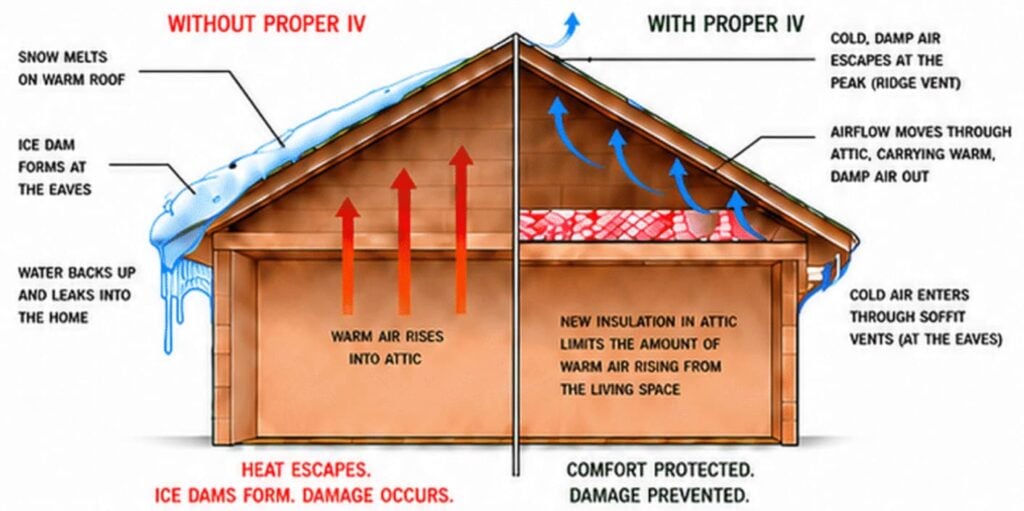
When heat escapes from the living space into the attic, it warms portions of the roof deck and melts the snow above. The resulting water flows toward the colder eaves, where it refreezes.
As the process continues, the ice buildup can prevent additional water from draining from the roof. Water may then back up beneath shingles and enter the building.
How Ice Dams Form
Ice dams typically develop through a five-step process:
- Heat escapes from the living space into the attic.
- Warm sections of the roof cause snow to melt unevenly.
- Meltwater travels toward the colder roof edges.
- The water refreezes and begins forming an ice dam.
- Additional water backs up behind the dam and may enter beneath the shingles.
The visible ice is only part of the problem. Moisture entering the building can damage insulation, drywall, ceilings, walls, finishes, and personal property.
Why Roofing Materials Are Only Part of the Equation
Community associations often inspect shingles, flashing, gutters, and other exterior roofing components. Those inspections are important, but the roof covering is not the only factor that influences ice dam formation.
Inadequate attic insulation and restricted airflow can create uneven roof temperatures—even when the roofing materials themselves are still in good condition.
Preventing ice dams requires looking at the entire roofing and attic system.
The “I” Stands for Insulation
Proper attic insulation helps keep heat in the living space, where it belongs, instead of allowing it to escape into the attic.
When warm indoor air reaches the underside of the roof deck, it can create warm spots that melt snow prematurely. Improving insulation helps maintain a more consistent roof temperature and reduces unnecessary heat loss.
The “V” Stands for Ventilation
Balanced attic ventilation allows colder exterior air to enter through intake vents—often located near the soffits—and warmer attic air to exit through exhaust vents near the roof peak.
This airflow helps maintain a more consistent attic temperature and reduces the freeze-thaw cycle that contributes to ice dams.
Effective ventilation may also help reduce trapped moisture, extend the life of roofing components, and improve the overall performance of the attic system.
Insulation and ventilation must work together. Adding insulation without evaluating airflow—or increasing ventilation without addressing major heat loss—may not fully correct the underlying issue.
The Benefits of Proper Insulation and Ventilation
A properly designed attic system can help community associations achieve several long-term benefits:
- Reduced risk of ice damming
- Fewer interior leaks and water-damage repairs
- Lower energy costs
- Longer roof-system life
- Fewer hazardous icicles
- Improved comfort for residents
- More predictable capital planning
These improvements can protect more than the building. They can also help protect the association’s operating budget and reserve funds.
Small Problems Can Become Large Capital Expenses
Minor attic deficiencies may be easy to overlook during warm weather. Once winter arrives, however, those deficiencies can contribute to recurring leaks, damaged insulation, deteriorated decking, interior repairs, mold concerns, and premature roof replacement.
For a multi-building community, the cost can multiply quickly.
Addressing insulation deficiencies, ventilation restrictions, icicles, airflow concerns, and drainage issues early can help associations avoid emergency assessments and unplanned capital expenses.
Don’t Wait Until Winter to Start Planning
The best time to correct attic insulation and ventilation issues is before cold weather arrives.
A professional inspection can help identify:
- Inadequate or uneven attic insulation
- Blocked soffit vents
- Insufficient intake or exhaust ventilation
- Air leaks from conditioned spaces
- Bathroom or kitchen exhaust fans venting into the attic
- Signs of moisture accumulation
- Previous ice dam or water damage
- Gutter and drainage concerns
The inspection findings can then be used to prioritize immediate repairs, future improvements, and reserve-budget planning.
Protect Your Community Before the Next Freeze
Ice dam prevention starts with understanding how heat, insulation, ventilation, roofing, and drainage work together.
KangaRoof works with condominium boards, community associations, and property managers to evaluate roofing and building-maintenance concerns before they become larger problems. Our team can inspect your buildings, identify potential issues, and help develop a plan for seasonal maintenance and long-term improvements.
Contact us today and start preparing your community before winter weather arrives.
Learn more about our Commercial Property Maintenance Program here.
