
Roof Insurance Claim Help
Clear answers about your roof and your claim from a local roofing team
After a storm, most homeowners have two questions: is the roof damaged, and will insurance help pay for it? Brandstetter’s KangaRoof can help you sort that out. During a free, no-obligation estimate, a KangaRoof advisor looks over your roof, photographs what they find, and explains whether it calls for a repair, a full replacement, or nothing at all. If you file a claim, your advisor can meet your insurance adjuster on site to go over the damage. Your insurance company decides what your policy covers. We give you a straight read on the roof and do the work right. KangaRoof has served homeowners in Greater Cincinnati, Dayton and Northern Kentucky for more than 25 years.
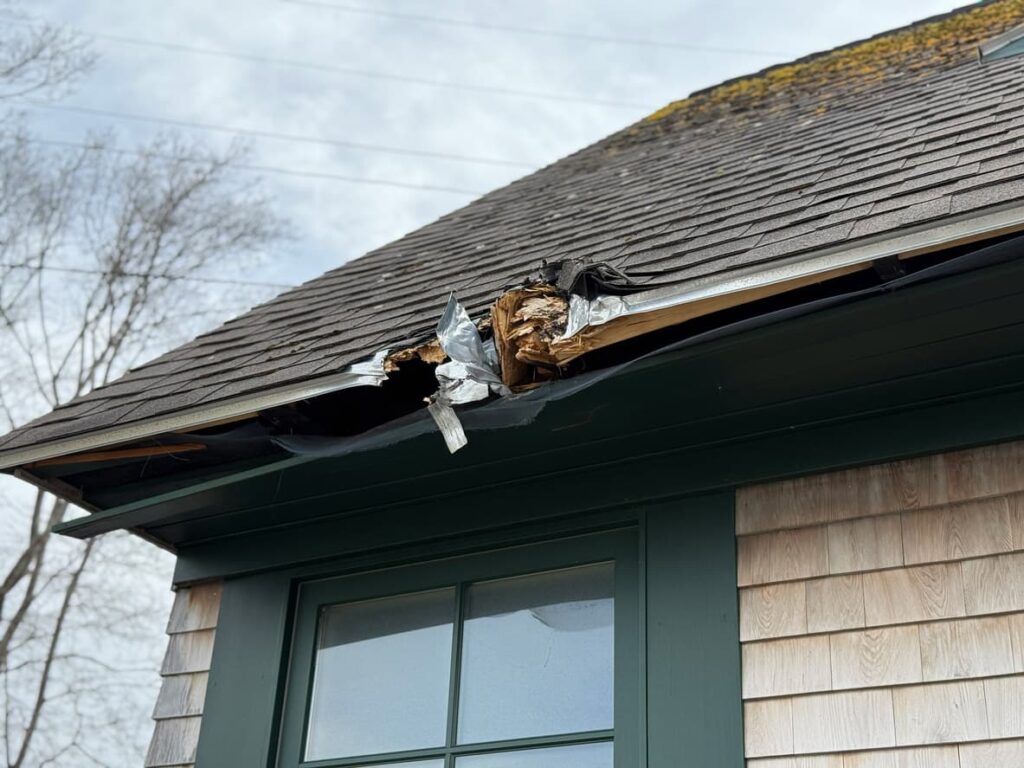
Signs your roof may have storm damage
In the spring, hail and straight-line wind never fails to move through the Cincinnati and Dayton regions. Their damage can be hard to spot from the yard. Do us a favor and stay off the roof and look for these signs from the ground instead:
- Missing, creased or lifted shingles, or shingle pieces in the yard
- Dents on gutters, downspouts, vents or window trim, which can point to hail damage on the roof too
- Shingle granules collecting in gutters or at the bottom of downspouts
- Bent or loose flashing around a chimney or skylight
- New water stains on ceilings or in the attic
- Cracked or dented siding and bent or pulled-away gutters
Plenty of roofs come through a storm with no real damage. If what we find is minor, or the repair would likely cost less than your deductible, we’ll tell you so you can decide whether a claim makes sense. For repairs after a storm, see our storm damage repair page.
Does homeowners insurance cover roof replacement?
Often, yes, when a sudden event like wind or hail damages the roof. Most homeowners policies cover that kind of damage, minus your deductible. Policies usually exclude wear and tear, old age and damage from skipped maintenance. Your insurance company makes the final call after its adjuster inspects the roof.
Usually covered
- Wind and hail
- Lightning and fire
- Falling trees or debris
- Weight of heavy snow or ice
- Vandalism
Usually not covered
- Wind and hail
- Aging or worn-out shingles
- Falling trees or debris
- Weight of heavy snow or ice
- Vandalism
What you pay on a roof insurance claim
Honest answer: it depends on your deductible and on how your policy pays for the roof. Your declarations page lists both.
Replacement cost value (RCV)
An RCV policy pays to replace your roof with materials of like kind and quality, with no deduction for the roof's age. Many RCV policies pay in two parts. The first check covers the roof's depreciated value. The insurer releases the held-back amount, called recoverable depreciation, once the work is finished and you send the final invoice.
Actual cash value (ACV)
An ACV policy pays what your roof was worth at the time of the storm, after age and wear are taken off. An older roof brings a smaller payment. You cover the gap. Some insurers limit older roofs to ACV coverage, so check which applies to yours.
Your deductible
Your deductible is the share of a covered claim you pay yourself. Some policies use a flat dollar amount. Others set a separate wind and hail deductible as a percentage of your home's insured value. A roofer who offers to cover or "absorb" it is a warning sign. In Kentucky, the law bars roofing contractors from making that offer.
Upgrades and your share of the project
Insurance pays for like-kind materials. If you choose an upgrade, such as moving from shingles to a metal roof, you pay the difference. KangaRoof offers financing through GreenSky® and Advancial® for your share of the work, including the deductible.
How to file a roof insurance claim, step by step
A roof claim runs from protecting the house to collecting the last payment. Start soon after the storm, since every policy sets a deadline for reporting damage.
1Keep everyone safe and limit water damage
Stay off the roof. Put buckets under drips and move belongings out of the way. If water is coming in, call us about a temporary repair. Keep the receipts, since many policies reimburse reasonable steps to prevent more damage.
2Document what you can see
Take dated photos and video from the ground, plus any ceiling stains and hail dents on gutters, decks or cars. Write down the date and time of the storm.
3Read your policy
Find your deductible, whether the roof is covered at replacement cost or actual cash value, and how long you have to report a claim.
4Get a roofer's opinion
A free estimate from KangaRoof shows you what the damage looks like and what a repair or replacement would involve. Claims can stay on your insurance record, so it helps to know up front whether filing makes sense.
5File the claim
Call your insurance company or use its app or website. Write down your claim number and the adjuster's contact information.
6Meet the adjuster.
The adjuster inspects the roof and writes up the damage. You can ask your KangaRoof advisor to be there to go over what we found.
7Review the settlement
Compare the adjuster's estimate with your roofer's estimate line by line. If something looks missing, ask your insurance company how to request a review.
8Schedule the work and close out the claim
Once you approve the project, we schedule your installation. If your policy holds back depreciation, send the final invoice to your insurer to request that payment.
How KangaRoof helps with your roof insurance claim
KangaRoof handles the roofing side of your claim. Your insurance company handles the coverage side. We’ve worked with a variety of insurance companies. The split stays the same with each of them.
What KangaRoof does
- Looks over your roof during a free estimate and explains what we find
- Photographs the damage and writes up the roofing work involved
- Meets your adjuster on site to go over the damage, if you'd like us there
- Answers your questions as the claim moves along
- Installs your roof, cleans up and backs the work with our guarantees
What your insurance company decides
- Whether the damage is covered
- How much the policy pays
- Your deductible and any depreciation held back
- Claim deadlines and paperwork
- Whether to approve a request for review
When your insurance company asks for a new roof
Some insurers require a roof replacement to renew a policy, even with no storm damage. Common triggers are roof age (often 15 to 20 years), curling or missing shingles, sagging, or several past roof claims. Because no single event caused the problem, the replacement is usually your cost.
If you got a non-renewal notice or an inspection report from your insurer, bring it to your estimate. Your KangaRoof advisor will go through what it calls out and quote a roof replacement that answers it. Financing can spread the cost over time.

Questions to ask any roofer about an insurance claim
Out-of-town crews often follow big storms door to door. These questions help you check out any roofer, including us.
- Where is your office? A local address means the company will be around if the roof needs attention later. KangaRoof’s offices are in Amelia and Waynesville, Ohio.
- Are your crews insured? Ask for proof. KangaRoof’s team members are fully insured.
- Can I read reviews from homeowners near me? See KangaRoof reviews.
- Will I get a written estimate? It should spell out the materials, the scope of work and the price.
- What guarantee comes with the work? Ask how long it lasts and who stands behind it. See our guarantees.
- Will you cover my deductible? A yes is a red flag. In Kentucky, a roofer offering to pay or rebate your deductible breaks state law.
- Do I have to sign today? Take time to read any contract. Kentucky homeowners can cancel within five business days after their insurer denies all or part of the claim in writing.
Roof insurance claims across the region

Severe spring and summer storms here can bring hail and wind gusts above 60 mph, with most hail falling between March and July.


Kentucky law (KRS 367.628) bars contractors, including roofers, from negotiating your claim for you or offering to pay or rebate your deductible. A roofer can still give you an estimate and talk with your insurer’s representative about the damage once you’ve filed.
Homeowners we've helped after a storm
He inspected my metal roof , measured & explained all the damage I had from a severe rain/wind storm. He was very thorough, kind & professional. REMOVED made contact with my insurance adjuster to explain the damage to him in detail.
– Carol D
Mark came out and inspected our roof after a recent storm. He took pictures and walked me through everything he found – no pressure, and explained what might and might not be an issue. They have also put in skylights for us in the past and other minor repairs. They are always our first call for any roof issues.
– Terry M.
Gerrit was very nice and explained the process and is help me with insurance which is a nightmare.
– Mason J.
Roof insurance claim FAQ
Will my homeowners insurance pay for a new roof?
How can I tell if my roof has hail damage?
Does Ohio require my insurer to match my shingles?
Ohio’s claims rule (Ohio Admin. Code 3901-1-54) says that when replacement pieces don’t match in quality, color, or size, the insurer must replace enough of the roof for a reasonably comparable appearance. That doesn’t guarantee a whole new roof. Courts decide matching case by case. If your shingle line is discontinued, tell your adjuster and keep proof. A roofer can help you find out whether your shingles are still made.
How long do I have to file a roof insurance claim?
How long does my insurance company have to respond in Ohio or Kentucky?
In Ohio, insurers must acknowledge a claim within 15 days. They must accept or deny it within 21 days of getting your proof of loss, or tell you why they need more time (Ohio Admin. Code 3901-1-54). In Kentucky, insurers must acknowledge a claim within 15 business days and pay within 30 days of accepting it (806 KAR 12:095). Keep a log of every call and letter.
Will filing a roof claim raise my insurance premium?
Can a roofer pay or waive my deductible?
Can I cancel a roofing contract if my insurance claim is denied?
In Kentucky, yes. You can cancel by midnight of the fifth business day after your insurer tells you in writing that all or part of the claim isn’t covered (KRS 367.622). The contractor can’t require payment up front until that window closes, except for emergency repairs. In Ohio, a contract you sign at home during a sales visit can usually be canceled by midnight of the third business day after signing (Ohio Rev. Code 1345.22).
Do I have to use the roofer my insurance company recommends?
What if my roof claim is denied or the payment seems too low?
What is recoverable depreciation?
Will insurance cover an older roof?
Will insurance cover an older roof?
Does KangaRoof help with siding, gutter, and window damage on the same claim?
Yes. Storms rarely hit only the roof. A single claim often covers siding, gutters, and windows too. KangaRoof handles all four, so your advisor can look over the whole exterior at your free estimate. See our storm damage repair page for more on exterior repairs.